


Trees have been telling the Oregon story since long before it became a state in 1859. Roughly 500 years ago, a ponderosa pine sprouted near the Deschutes River in Central Oregon, starting a journey that would culminate with it becoming the biggest of its kind. Others aren’t quite as big or grand, but capture important moments of our history, like the tiny Comice pear grove in Medford that began Harry & David, one of Oregon’s most iconic companies.
Those trees, and a few dozen more across the state, have in recent years been immortalized in the Oregon Heritage Tree Program, which is celebrating its 30th anniversary in 2026. Here are some notable examples and tips for visiting these historic trees.
How Oregon Launched the Nation’s First Heritage Tree Program
The seeds for the Oregon Heritage Tree Program were first planted in 1994, when activist and nature lover Maynard Drawson approached the Oregon Travel Information Council about forming a committee to honor the state’s most historically significant trees. At the time, trees were most commonly noted for their size. Drawson and a group of supporters successfully argued that Oregon should go beyond measurements and also recognize trees for attributes that couldn’t be quantified, like heritage and cultural impact.
When the Heritage Tree program launched in 1996, Oregon became the first state in the nation to create a program celebrating the historic nature of its trees, and it now has 85 official Oregon Heritage Trees, 79 of which are still living today.
“It’s an expression of the fullness of this place and the people who live here,” says Dave Hedberg, chair of the Oregon Heritage Tree Committee. “Everybody, whether you’re a logger or a tree hugger, has reverence for those big trees.”
Heritage Tree Program Evolves to Improve Representation
In 2021 Nuu-k’wii-daa-naa~-ye’ Sitka Spruce, near Devils Lake in Lincoln City, was added to the Heritage Tree Program. Named “Our Ancestor” in the local Siletz Dee-ni language, the 212-foot-tall tree was nominated by a member of the Confederated Tribes of Siletz Indians and serves as a lasting legacy. “The people in the community see it as a moment for all of us to reflect on our ancestors,” Hedberg says.
The tree’s inclusion is a clear example of how the Oregon Heritage Tree Program has evolved to reflect the stories and experiences of the state’s many communities. It gives more weight to cultures that relied on oral traditions over written records. “It’s really broadened the types of stories that we’re interested in highlighting,” Hedberg says. The committee also invites groups like foresters, horticulturists, history buffs and others to expand the scope of which trees are selected.
See Some of Oregon’s Most Notable Heritage Trees Today
Today Oregon Heritage Trees cover the state. Start your travel planning by viewing an interactive map that shows where to find these iconic trees. For more inspiration, here are a few favorites you can visit on your travels throughout the state. Just remember to respect the trees and their natural environment by remaining on trails, packing out waste and respecting posted rules.
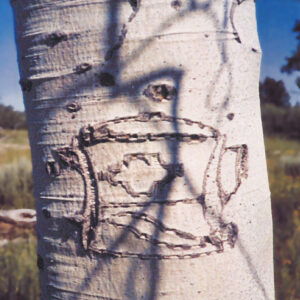
Aspen Arborglyph Trees, Frenchglen
On your next visit to Eastern Oregon’s Steens Mountain, check out the Aspen Arborglyph Trees at Fish Lake Campground. The aspen trees bear numerous carvings by Basque sheepherders who worked on the mountain in the early to mid-1900s. According to Hedberg, those carvings are how the sheepherders would communicate with each other. Since this community did not leave many written records, it reflects an important way to document their place in Oregon history.
Sitka Spruce at Klootchy Creek, near Seaside
In 1997 a 216-foot-tall Sitka spruce in Klootchy Creek County Park, just a few miles inland from Seaside and Cannon Beach on the Oregon Coast, became the first official Oregon Heritage Tree. The spruce was one of the state’s largest trees at the time of its selection, but a 2007 windstorm cleaved the tree along an old lightning scar about 80 feet off the ground, sending its crown tumbling to the ground. Today, visitors can see a massive stump, which measures 17 feet across, via a short, flat path from the parking area.
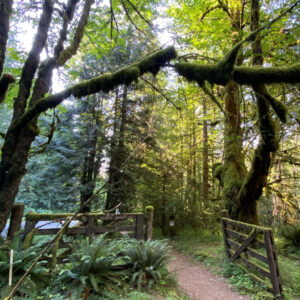
Moon Tree, Salem
In 1971 astronaut Stuart Roosa packed along an unusual piece of cargo on the Apollo 14 moon mission: a Douglas fir seed. After it returned from the moon, that seed was planted in 1976 in Salem’s State Capitol State Park. Today the Moon Tree is about 63 feet tall. Learn more about it — along with other significant trees, shrubs and historic sites — on a walking tour of the grounds.
Barlow Road Tollgate Maples, Rhododendron
On your next trip to Mt. Hood, make a quick detour to learn about local history at the Barlow Road Tollgate Maples just outside Rhododendron. The 60-foot trees surround a replica tollgate from the Barlow Road — a pay-to-use branch of the Oregon Trail for wagons heading over the Cascades. It’s believed the trees were planted by a former tollgate keeper almost 140 years ago.
Big Tree, La Pine
In LaPine State Park, just north of La Pine in Central Oregon, the 500-year-old Big Tree is the largest ponderosa pine ever recorded. From the parking area, follow a paved path as it gently descends to the base of the tree, which measures 162 feet tall, nearly 29 feet around and more than 8 feet across.
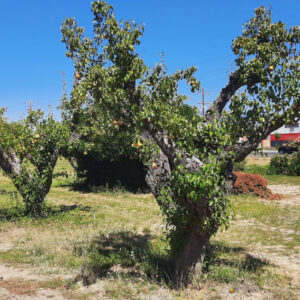
Harry & David Comice Pears, Medford
See how Harry & David rose from a small fruit orchard to an Iconic Medford business by visiting the Harry & David Comice Pears. The small grove, dating back to the 1930s, is all that’s left of the company’s original plantings of Comice pears. Learn more about the company’s past and present — and see the grove from your shuttle — on a guided Harry & David factory tour.
John Quincy Adams Young House Fruit Trees, Beaverton
The newest Oregon Heritage Tree, dedicated in September 2025, is actually a collection of three trees. The JQA Young House Fruit Trees, housed in a small park just west of Portland, represent one of the few instances where homes from the mid-1800s and their adjoining fruit trees have survived more than a century largely intact. As Hedberg says, it’s not unusual for a home or a fruit tree to remain after more than 150 years, but almost never together. One tree is shagbark hickory, and the others produced pears and apples.