





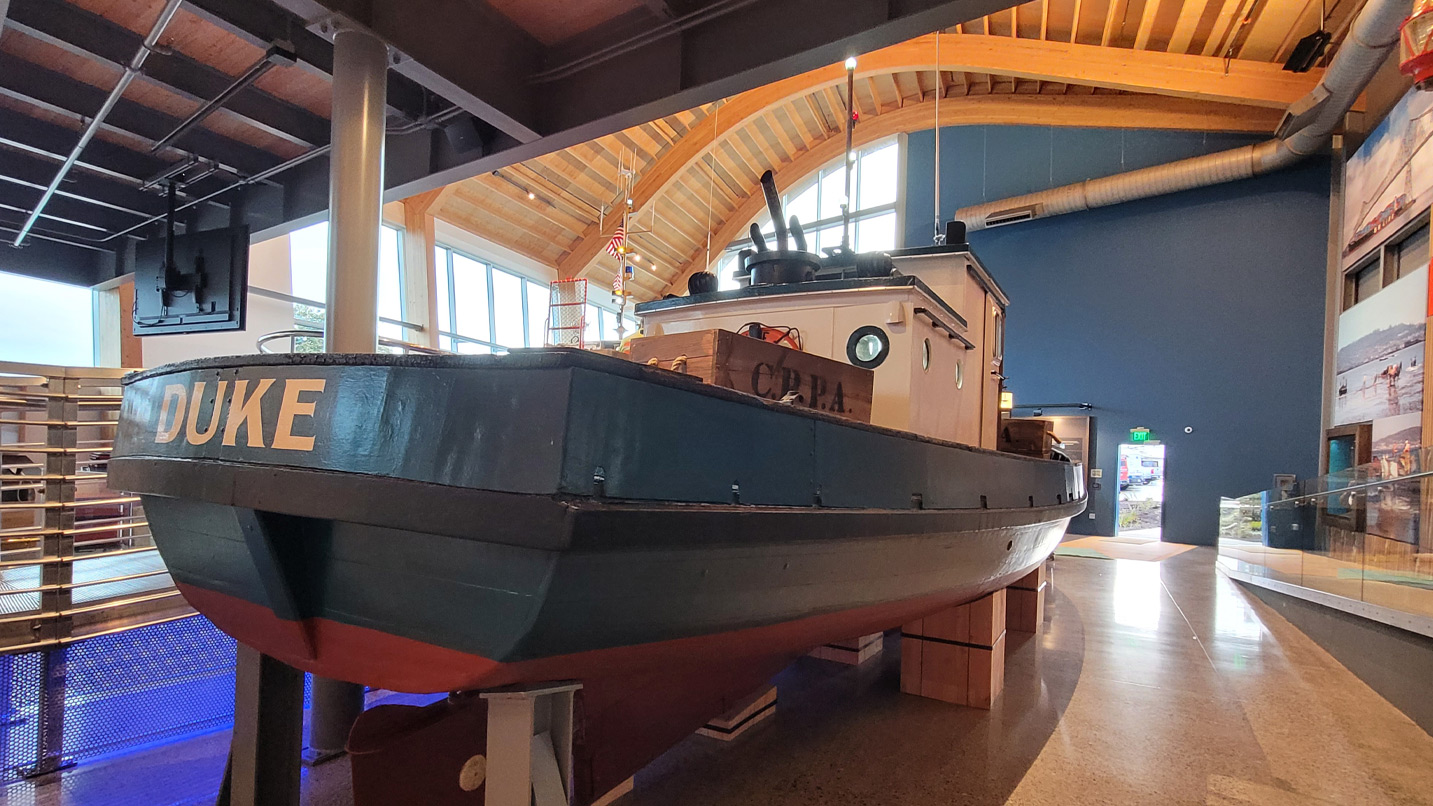
Out where the Columbia River meets the Pacific, the waves never let up. They were breaking against the Columbia River Bar long before any ship’s log recorded them, when Chinookan paddlers guided cedar canoes through the surf. And they were breaking in 1902, when Astoria’s Wilson Brothers Shipyard launched a salmon tender called Duke.
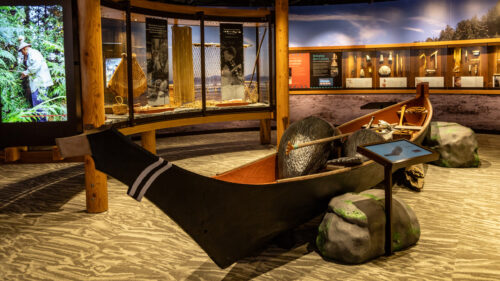
More than a century after it was built, Duke is back on the Astoria waterfront, this time under a roof. The Columbia River Maritime Museum Warnock Building, home of Mariners Hall, is a brand-new soaring two-story building with more than 24,500 square feet of exhibit and classroom space. It brings Duke and many other vessels out of storage. Visitors reach it by walking through a gallery created with the Chinook Indian Nation, so the experience begins with the people who have made their lives on this water for thousands of years. It’s a place to watch, listen and learn. Here’s how to plan your visit.
A New Building That Reflects Astoria’s Maritime Heritage
The name Mariners Hall was intentionally chosen to reflect the human stories behind the boats. “It’s about the human experience, the mariner, hence Mariners Hall, to show we are focused on the people that built these boats and other craft, operated them and maintained them, and how it impacted our community,” says Columbia River Maritime Museum executive director Bruce Jones.
The process of creating Mariners Hall also reflects the community behind it. The museum raised nearly $34 million for the project entirely through private philanthropy, and most of the subcontractors who built it were local. The stories inside belong to this place, too. The new galleries give the museum room to grow its display of full-size boats from five to 19, along with space for hundreds of artifacts that have spent years in storage.
Several of the vessels soon to be on display, including Duke, were built within a few miles of where they now sit. The wooden yacht Merrimac was built nearby at Astoria Marine Construction Company in 1938. Others came from up the river, including a World War II lifeboat built at Portland’s Gunderson Marine.
Exhibit design firm Storyline Studio and Portland-based Opsis Architecture set out to make the boats feel alive even ashore. “Imagine an exhibition in which you can explore every vessel from all kinds of angles — even get aboard some of them,” says Storyline principal Bill Smith. “And then get the chance to meet the mariners themselves.”
See a Helicopter Up Close and Power Your Own Propeller
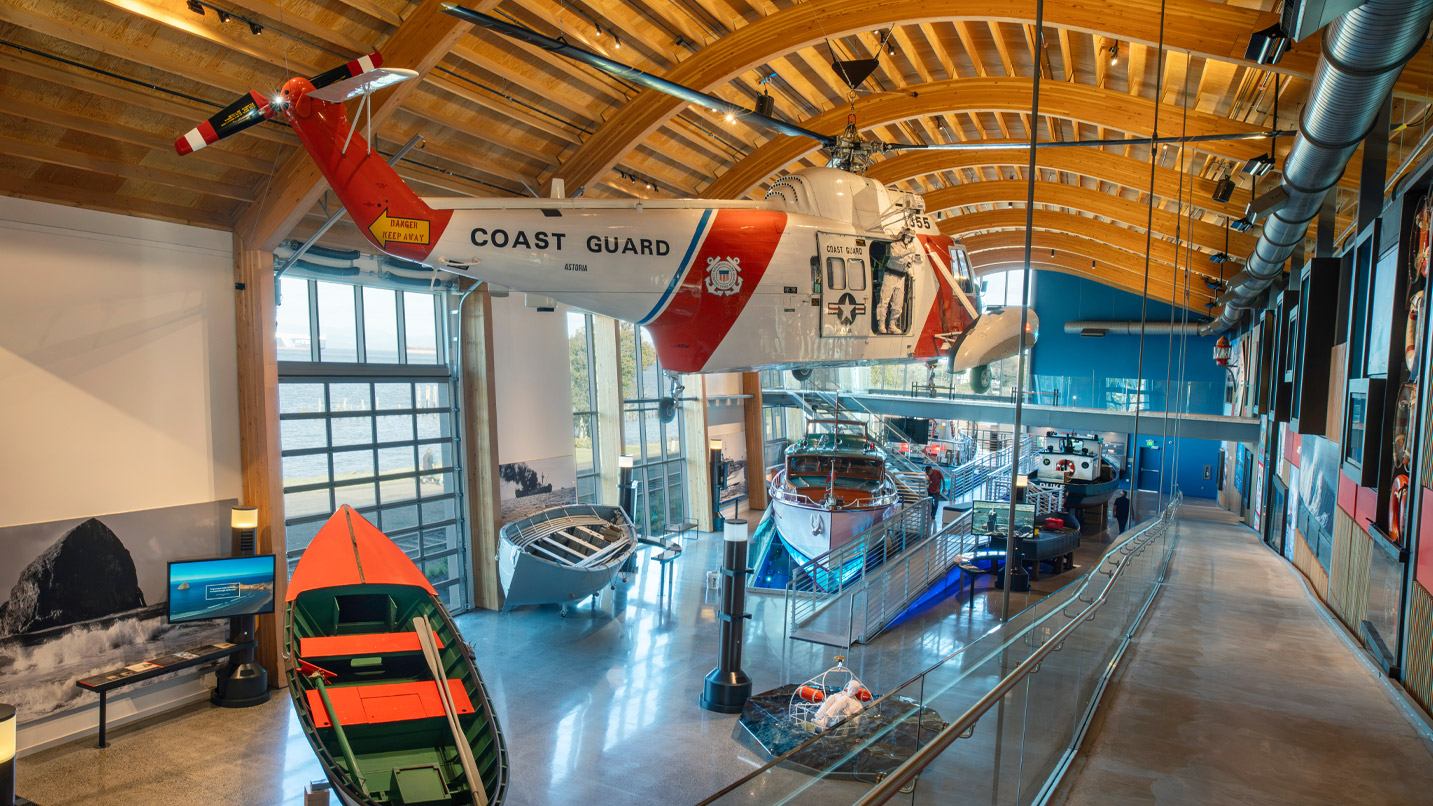
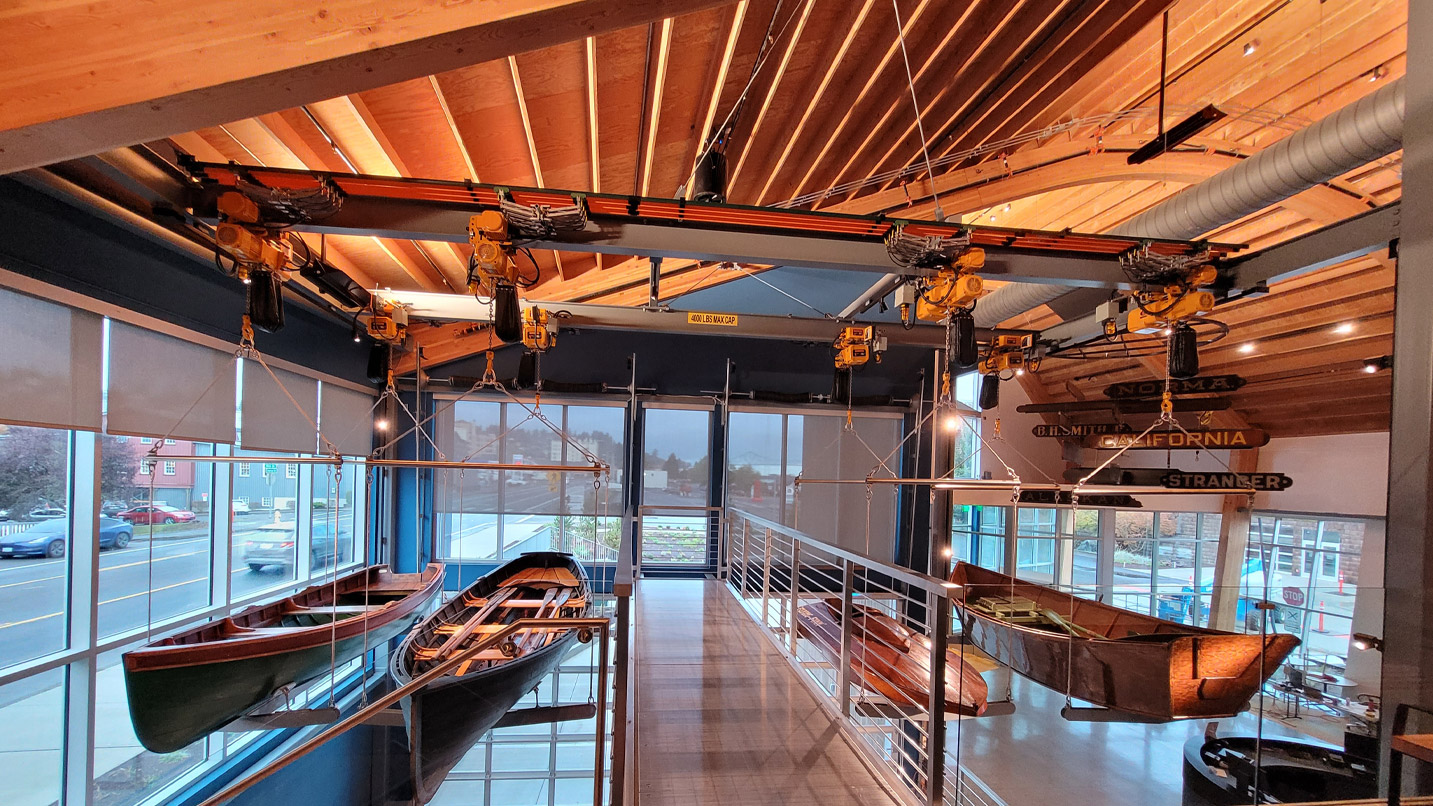
The heart of the building is a two-story gallery holding 10 vessels, staged so visitors can see them from multiple viewpoints. Overhead, a Coast Guard search-and-rescue helicopter hangs as if in the middle of a high-risk rescue, and visitors can view it from four different levels. Nearby stands a first-order Fresnel lens, the largest and most powerful class of lighthouse lens, built in Paris in 1876.
Visitors can also climb aboard some vessels, including experiencing what it feels like to ride a “log bronc,” a small tugboat once used to corral logs on the river and herd them safely on to the sawmill. Elsewhere, the double-height Boat House showcases a changing selection of recreational boats. The Bulkhead, a two-story installation running the length of the building, puts objects, images and interactive exhibits from the collection on view, many for the first time.
Families will want to head straight for STEAMworks, 2,400 square feet of hands-on exhibits where kids can provide pedal power for a giant propeller, experience the kinetic energy of a flywheel or discover what it takes to sail into the wind. Throughout the hall, short documentaries by Portland’s North Shore Productions introduce mariners of all kinds, from transpacific rowers and bar pilots to dorymen and Coast Guard rescue crews.
Soak Up Architecture Inspired by the Sea
The building itself is also a showpiece. Curved wooden beams spanning up to 60 feet form an all-wood roof that arches over the boats, and 20-foot windows frame Columbia River views. The design also reduces both energy use and carbon footprint through high-efficiency windows, lighting, insulation and mechanical systems.
Mariners Hall also gives the museum something it has never had: a dedicated classroom. The space will host school-based programs for students from across the region, along with adult education classes.
“With so many people passing through Astoria, our goal has been to create an experience that every one of them can enjoy,” says Smith. “In Mariners Hall, visitors will get an up-close experience of every vessel and encounter the mariners who have been drawn to these waters.”